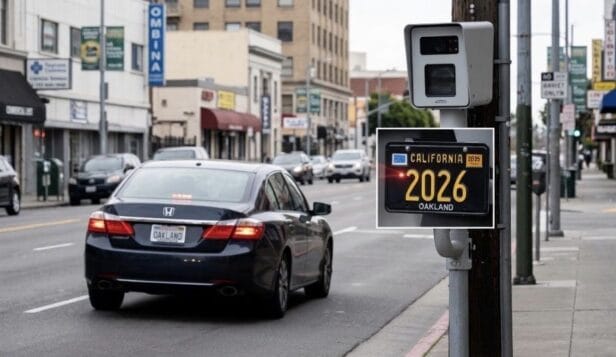
The “grace period” for drivers in Oakland has officially ended. Starting Sunday, March 15, 2026, the automated speed enforcement system will switch from issuing warnings to issuing actual fines. The city has summarized the results of the test period, and the numbers are impressive: in the first five weeks, cameras recorded more than 140,000 violations.
The program was launched under California’s AB 645 law. Oakland is one of six cities in the state (along with San Francisco and San Jose) where this pilot project is being implemented. Its goal is to enforce speed reductions on the most dangerous stretches of road.
Scale of violations and statistics
During the “grace period,” which began on January 14, the system operated in training mode. Approximately 74,000 unique warnings were sent to drivers. Statistics showed that, on average, there are about 3,600 speeding violations per day in the city.
Nearly half of the drivers were caught speeding only once, but a significant portion of motorists ignored the warnings and violated the rules twice or more. Starting today, such carelessness will cost them money.
How the Fines System Works
The mechanics of the process are strictly regulated by law to strike a balance between safety and privacy:
Technical Monitoring: Cameras capture only the rear license plate of the vehicle. Photographing drivers’ faces or the interior of the vehicle is prohibited by state law.
Threshold: A ticket is issued only if your speed exceeds the posted limit by 11 mph or more.
Legal status: The violation is classified as a Civil Penalty. This means you will not receive DMV points, and the incident will not affect your insurance rates.
Recipient: The citation is mailed to the registered owner of the vehicle.
Fines in 2026
The amount on the citation depends directly on how much you exceeded the speed limit:
$50 — for exceeding the limit by 11–15 mph.
$100 — for exceeding the limit by 16–25 mph.
$200 — for exceeding the limit by 26 mph or more.
$500 — for critical speeds exceeding 100 mph.
Significant discounts are available for low-income residents. The fine may be reduced by 50–80%, and in some cases, replaced with community service.
Where to Be Especially Careful
Oakland has installed 35 cameras at 18 locations. These are sections of the so-called High-Injury Network, where approximately 60% of all serious accidents in the city occur.
List of locations with the highest number of violations based on test results:
Broadway (between 26th Street and 28th Street) — a record 21,000 violations were recorded here.
73rd Avenue (from Fresno Street to Krause Avenue) — an average of 457 citations per day.
Hegenberger Road (from Spencer to Hawley Street).
98th Avenue, 7th Street, West Grand Avenue, Foothill Boulevard, and International Boulevard.
Why this matters to the community
City officials emphasize that, on average, two people in Oakland are seriously injured or killed in traffic accidents every week. Speeding is the primary cause of these statistics. By law, all funds collected from fines will be used exclusively to improve road infrastructure and enhance traffic safety.
For those who want to check the exact locations of all cameras, the city has published detailed information on the website oaklandca.gov/speedcameras.