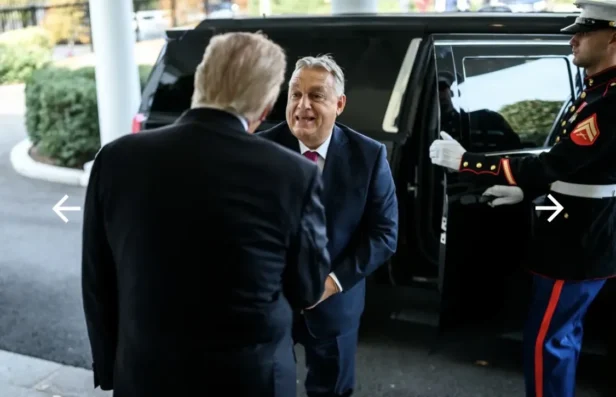
Hungarian Prime Minister Viktor Orbán conceded defeat Sunday after 16 years in power, as opposition party Tisza secured a commanding victory in parliamentary elections. With 77% of ballots counted, Tisza led with 53% of the vote against 38% for Orbán’s ruling Fidesz-KDNP coalition, according to the National Election Office.
The results give Tisza approximately 135 of 199 parliamentary seats — a two-thirds constitutional majority that mirrors the supermajority Orbán used to reshape Hungary’s institutions over nearly two decades.
Voter turnout reached 77.8%, the highest in Hungary’s post-communist history and well above the previous record of 70.5% set in 2002.
“The election result is not yet final, but the situation is clear,” Orbán said at Fidesz headquarters. He congratulated the winners and promised to serve Hungary from opposition. Tisza leader Péter Magyar described himself as “cautiously optimistic” and urged supporters to remain calm.
Magyar’s rise from insider to opposition leader
Magyar was part of Orbán’s system just two years ago. A lawyer and former Fidesz member, he was married to former Justice Minister Judit Varga. He broke with the party in February 2024 amid a scandal over presidential pardons for accomplices of a convicted pedophile.
By March 2024, Magyar had announced a new political movement. He took over the little-known Tisza party (Tisztelet és Szabadság, meaning “Respect and Freedom”) to bypass bureaucratic barriers for registering a new organization.
Tisza finished second in June 2024 European Parliament elections with 30% of the vote — the opposition’s best showing since 2006. Magyar then launched an intensive nationwide campaign, establishing 208 local chapters and visiting hundreds of towns. In the final days before elections, he campaigned in six cities daily.
The party’s platform focused on fighting corruption, improving failing public services in healthcare and transportation, and returning Hungary to the European mainstream. Magyar positions himself as a “critical pro-European” and “conservative liberal.” Tisza belongs to the European People’s Party, the largest centrist group in the European Parliament that includes governments from 12 of 27 EU countries.
Economic stagnation undermines Fidesz
Three years of economic stagnation eroded Fidesz’s electoral base, according to analysts. Rising living costs hit even rural regions that traditionally supported Orbán. A leaked Russian intelligence report obtained by The Washington Post showed 52.3% of Hungarians were dissatisfied with the country’s direction, including 50.8% of rural residents.
A series of scandals in recent weeks damaged Fidesz further. In February, Hungarian outlet Telex published an investigation into toxic emissions at a Samsung SDI battery plant in Göd. Workers were exposed to carcinogenic heavy metals at concentrations hundreds of times above safe limits. The government denied problems existed.
The final blow came from leaked audio recordings of phone calls between Hungarian Foreign Minister Péter Szijjártó and Russian Foreign Minister Sergei Lavrov. The recordings, published by investigative consortium VSquare, The Insider and other outlets, captured conversations from 2023 to 2025. Szijjártó called Lavrov between EU Council meetings to share details of closed discussions, offered to send EU documents through Hungary’s Moscow embassy, and coordinated blocking Ukraine’s EU membership bid.
France called Budapest’s actions treasonous. The European Commission demanded explanations. Szijjártó dismissed the leaks as a “foreign intelligence operation” to interfere in elections.
Russian interference campaign
The scale of Russian interference in Hungary’s elections may be unprecedented in EU history, according to security analysts.
The Washington Post in March published a Russian Foreign Intelligence Service document obtained and verified by a European intelligence agency. Russia’s “active measures” unit developed a plan codenamed “The Gamechanger” to stage an assassination attempt against Orbán. The goal was shifting the campaign “from rational socio-economic issues to emotional terrain focused on state security and political system stability.” Publication of the plan likely prevented its implementation, experts said.
The Kremlin simultaneously launched a massive information campaign. Russia-linked Social Design Agency prepared memes, videos and infographics for Hungarian audiences, portraying Orbán as a sovereign leader and Magyar as a “Brussels puppet.” Ethnic Hungarians in Ukraine’s Transcarpathia region received threatening calls from spoofed Ukrainian numbers that Ukrainian security services traced to Russian territory.
A week before elections, Serbian authorities discovered two backpacks containing plastic explosives near a TurkStream pipeline branch close to Hungary’s border. Orbán immediately blamed Ukraine. Security expert András Rácz and other analysts had publicly predicted this incident three days earlier, including the location and “Ukrainian” framing.
The stakes for Moscow are high. Orbán served 16 years as Russia’s primary ally within the EU and NATO, blocking Ukraine aid packages, delaying sanctions and purchasing Russian oil and gas despite EU policy. His latest major move was blocking a 90 billion euro loan to Ukraine.
Unprecedented US intervention
Five days before voting, US Vice President JD Vance arrived in Budapest for a two-day visit — an unprecedented step of a high-ranking foreign official openly campaigning for a candidate in another country’s parliamentary elections.
At a rally in MTK Sportpark before 1,000 Fidesz supporters, Vance directly urged votes for Orbán. He called Trump during his speech, and the president told the crowd over loudspeaker: “I love Hungary, and I love Viktor. I’m with him all the way.”
Two weeks earlier, Budapest hosted CPAC Hungary, the fifth Hungarian conference of American conservatives. Participants included Argentine President Javier Milei, Georgian Prime Minister Irakli Kobakhidze and Dutch politician Geert Wilders. Trump sent a video message with “full endorsement” of Orbán.
The visit’s price tag for Hungary’s budget included commitments by state oil company MOL to buy $500 million in US oil and military purchases of $700 million in HIMARS missile systems.
Budapest analysts saw minimal impact from the visit. “A Trump visit might have influenced the campaign. Vance is barely known in Hungary,” said political scientist Zoltán Ranschburg. András Bíró-Nagy of Policy Solutions noted the government “overestimated the likely effect of this visit.”
The elections created an unprecedented paradox: Washington and Moscow openly supported the same candidate for the first time in Central European political history.
EU celebrates end of obstruction
European reaction was immediate. European Commission President Ursula von der Leyen wrote: “The heart of Europe beats stronger in Hungary today. Hungary chose Europe.” French President Emmanuel Macron called Magyar with congratulations. Prime ministers of Finland, Norway and Estonia welcomed the result.
For the EU, Orbán’s defeat removes its biggest internal problem in recent years. Hungary, with 9.5 million people, regularly paralyzed the bloc’s foreign policy using veto powers. Orbán blocked financial aid to Ukraine, delayed Russia sanctions and obstructed Ukraine’s EU membership bid. The new government will likely abandon systematic veto tactics.
Tisza’s manifesto promises to “choose Europe,” restore trust with the EU and NATO, join the eurozone by 2030 and unblock 18 billion euros in frozen European funds withheld over rule-of-law concerns.
For Renew Europe and the EPP, the two largest pro-European groups in the European Parliament, Hungary’s results strengthen positions in EU reform debates. Parliament Vice President Sophie Wilmès declared: “Orbán’s illiberal, authoritarian model is neither inevitable nor irreversible.”
Cautious hope for Ukraine
The situation for Ukraine is more complex than Kyiv might prefer.
Magyar will end Hungarian vetoes on Ukraine aid and stop sabotaging Russia sanctions. He will build more constructive relations with Brussels. But Tisza’s position toward Ukraine itself remains cautious.
In the European Parliament, Tisza deputies repeatedly voted with Fidesz on Ukraine-related issues, abstaining from supporting stronger language on aid to Kyiv and condemnation of Russia. Magyar publicly demanded apologies from President Volodymyr Zelensky for harsh statements about Orbán. Tisza opposes accelerated EU membership for Ukraine. On energy independence from Russia, Magyar proposes a 2035 timeline, significantly later than the EU’s 2027 goal.
A longstanding conflict remains over ethnic Hungarian rights in Ukraine’s Transcarpathia region. Russian propaganda deliberately inflamed this issue during the campaign. Even a new government will inherit a society largely convinced that “Ukrainians wanted to blow up the gas pipeline and kill the prime minister.”
German Marshall Fund analysts warn Magyar will “gradually reorient” rather than “break” foreign policy. Progress will be slow and careful.
The two-thirds trap
Constitutional majority presents both opportunity and risk.
The supermajority allows Magyar to reverse Orbán’s constitutional amendments, restore independence of courts, media and other institutions that Fidesz systematically subordinated since 2010. The European Parliament labeled Hungary under Orbán a “hybrid regime of electoral autocracy.” Returning the country to full democracy requires constitutional changes.
But this represents the same unchecked power Orbán wielded. Constitutional majority enabled his reshaping of Hungary. Verfassungsblog scholars warn Tisza risks a “double trap” — satisfying populist electoral expectations while concentrating unlimited power without institutional checks. How Magyar uses this mandate remains an open question.
What’s next
Final results may not be announced before Saturday, April 19. Hungary’s electoral system is complex, and high turnout will delay counting. But the outcome is clear. Magyar will become Hungary’s new prime minister.
For the 62-year-old Orbán, this marks the end of an era. For Putin, the loss of his primary ally within the EU. For Trump, an image blow after his administration invested in foreign elections and lost. For the EU, a historic chance at consolidation. For Ukraine, cautious hope.
Thousands of Tisza supporters gathered along the Danube embankment in Budapest, waving Hungarian flags, embracing and crying. Writer András Petöcz told CNN: “I was 30 when the communist regime collapsed. This is the same feeling. Exactly the same.”
Photo: Official White House Photo