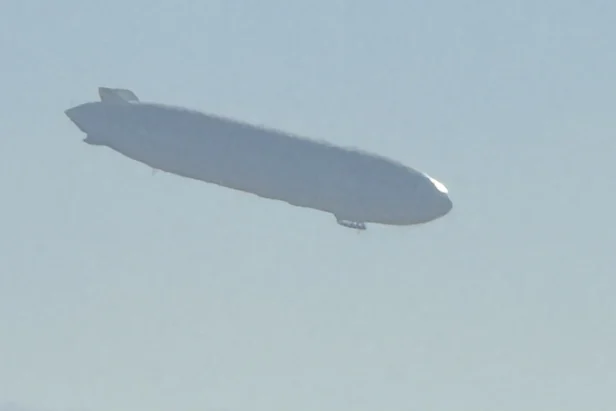
On Friday, March 20, Google invited officials, members of Congress, and journalists inside Hangar One at Moffett Federal Airfield in Mountain View. The occasion: completion of a four-year restoration of one of the largest freestanding structures in the world. The hangar is 1,130 feet long, 310 feet wide, and 200 feet tall — lay San Francisco’s Salesforce Tower on its side and it fits inside.
Hangar One was built in 1933 for the USS Macon, a massive U.S. Navy airship. The Macon flew for just two years before crashing in a storm off Point Sur in 1935. The hangar stayed. The military used it for training aircraft and anti-submarine patrols until Moffett Field closed in 1994, when it was transferred to NASA.
A Toxic Skeleton
In 2003, NASA discovered that the hangar’s metal cladding was poisoning the wetlands around Moffett Field. PCBs — toxic compounds banned in the U.S. decades ago — were leaching from the walls. Lead paint and asbestos were also found. Attempts to seal the walls with a protective coating failed.
In 2005, the Navy proposed demolishing the hangar. South Bay residents pushed back hard. Former Mountain View Mayor Lenny Siegel formed the Save Hangar One committee. Thousands signed petitions. Hundreds showed up to public hearings. Military veterans called the hangar a symbol of their service. Historians called it a one-of-a-kind monument to the airship era.
Rep. Anna Eshoo, who represented the South Bay in Congress, personally persuaded then-Navy Secretary Raymond Mabus not to destroy the structure. The cladding was stripped — but the frame was spared. For more than a decade, the hangar stood as a bare steel skeleton in the middle of Silicon Valley, visible from Highway 101.
$1.16 Billion and a 60-Year Lease
In 2014, NASA announced a competition to lease 1,000 acres of Moffett Field, including three airship hangars. Planetary Ventures — a Google subsidiary — won. The deal: a 60-year lease for $1.16 billion. The main condition: the tenant must restore Hangar One.
Restoration began in May 2022. Workers stripped the remaining toxic cladding, cleaned the steel frame of lead paint and PCBs, reinforced the structure, and re-clad the hangar while preserving its historic appearance. The project consumed one million man-hours. General contractor: McCarthy Builders. Project management: CBRE. Design: HDR. Structural engineering: KPFF.
In December 2025, Planetary Ventures announced the work was complete. In February 2026, the EPA confirmed the toxic cleanup was finished.
What Comes Next
Google has not yet announced what will go inside the hangar. But there are hints. Company spokesperson Chris Alwan, asked about potential office space, said the option exists — and noted that Google already has experience working in a historic hangar: its Playa Vista office in Los Angeles occupies the building where Howard Hughes once kept the Spruce Goose.
Eugene Tu, director of NASA Ames Research Center, sees broader possibilities. Adjacent to Hangar One, on 36 acres, UC Berkeley is planning the Berkeley Space Center — a major research complex. Tu says the hangar and the new center together could create an innovation ecosystem for all of Silicon Valley.
At Friday’s ceremony, Anna Eshoo — now a former congresswoman — delivered remarks. A commemorative plaque was unveiled in her honor on the hangar wall. Rep. Zoe Lofgren, who grew up five miles from Moffett Field, put it simply: without Eshoo and without Google, this hangar wouldn’t exist anymore.
Hangar One is 93 years old. It was built for a military airship that crashed two years in. It was contaminated with toxins for half a century. There were plans to tear it down. Now it has a roof again — and may soon become the place where Silicon Valley figures out whatever comes next.