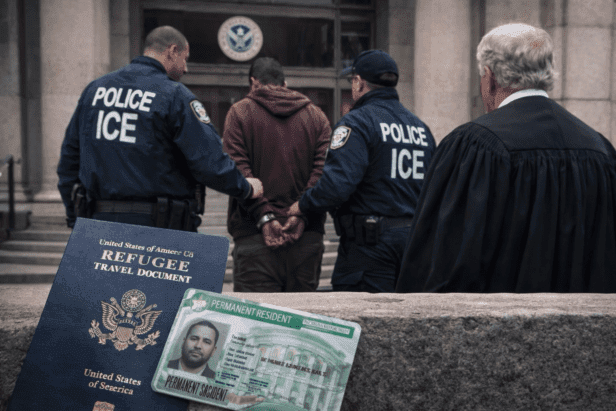
On March 23, federal Judge Richard G. Stearns of the U.S. District Court in Massachusetts temporarily blocked a Trump administration policy that allowed immigration authorities to detain refugees who had not applied for adjustment of status within one year of arriving in the United States. The order remains in effect for the duration of the litigation.
What happened
Six refugees from Rwanda, Iraq, Afghanistan, and Sudan, joined by two nonprofits — Jewish Family Service of Western Massachusetts and the International Institute of New England — filed suit on February 27. Attorneys from Democracy Forward and the International Refugee Assistance Project argued the DHS policy contradicted federal law and four decades of settled practice. Judge Stearns agreed. The Trump administration did not contest the plaintiffs’ motion for a temporary restraining order.
The legal dispute: custody is not detention
At the center of the case is a single word. Federal law (8 U.S.C. § 1159) requires refugees to “return to the custody” of DHS one year after entry for status adjustment processing. Since the Refugee Act of 1980, that had always meant appearing for an interview — nothing more.
In December 2025 and February 2026, DHS issued two internal memoranda reinterpreting the word. “Custody” was now read literally: a refugee who had not filed for a Green Card after one year could be physically detained indefinitely.
Judge Stearns ruled that “custody” in this context had never historically meant detention. DHS was substituting one legal concept for another. Custody here describes an administrative procedure, not grounds for incarceration.
The court added a second argument: the law requires refugees to “return” to custody — but refugees entering the United States are never placed in detention to begin with. You cannot return someone to a place they were never held.
Scale of the policy
More than 100,000 refugees nationwide were subject to the policy. Many had already filed Green Card applications and were waiting for processing. DHS had simultaneously frozen application review for refugees from 39 countries, including Haiti, Afghanistan, and the Democratic Republic of Congo — punishing people for failing to complete a process the government had suspended.
Background: Operation PARRIS in Minnesota
The detention policy surfaced publicly in January, not February. On January 9, 2026, DHS launched Operation PARRIS — Post-Admission Refugee Reverification and Integrity Strengthening — in Minnesota, home to one of the country’s largest Somali diaspora communities. ICE agents in plain clothes showed up at homes, stopped refugees on streets and on their way to work, and transported them to detention facilities in Texas — in some cases without warrants.
Roughly 150 refugees were arrested in Minnesota over three weeks. Some were questioned without attorneys. Others were released onto the streets of Texas cities without money, identification, or a way home. On January 28, federal Judge John R. Tunheim issued a temporary restraining order covering Minnesota. The March 23 ruling extends that protection nationwide.
What the ruling means now
While the case proceeds, DHS and ICE cannot enforce the December 18, 2025 and February 18, 2026 memoranda. The 2010 policy remains in effect. The absence of an adjustment of status filing under 8 U.S.C. § 1159 is not, by itself, grounds for arrest or removal proceedings.
The order is temporary. The Trump administration can appeal or mount a defense in court — something it has not yet done.