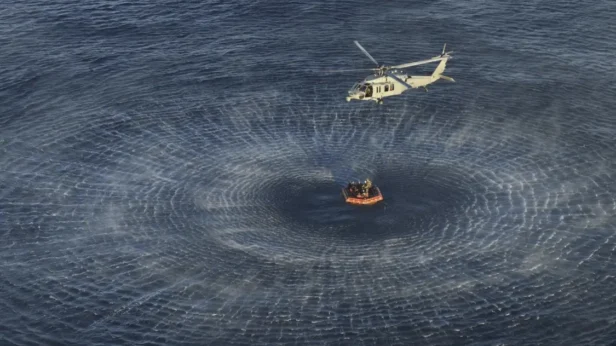
Four astronauts splashed down in the Pacific Ocean off San Diego at 5:07 p.m. Pacific time yesterday, returning from humanity’s first crewed mission to the moon in 54 years. The Orion capsule carried three Americans and one Canadian back from a 10-day lunar flyby, marking the end of the Artemis II mission.
The crew completed the journey despite lingering concerns about whether their heat shield would survive atmospheric reentry — a problem that had plagued NASA engineers since an unmanned test flight two years ago.
The Crew
Mission commander Reid Wiseman, pilot Victor Glover, mission specialist Christina Koch and Canadian Space Agency specialist Jeremy Hansen made up the crew. Glover became the first Black astronaut to fly to the moon. Hansen became the first Canadian to travel beyond low Earth orbit.
NASA selected the crew in April 2023, but the launch was delayed three times before lifting off April 1.
The Mission
The Space Launch System rocket launched from Kennedy Space Center in Florida, sending the Orion capsule — dubbed “Integrity” by the crew — on a free-return trajectory around the moon using the same flight path as the Apollo missions.
On April 6, Orion flew within 4,067 miles of the lunar surface and passed behind the far side of the moon. Radio contact with Earth was lost for 40 minutes as the moon blocked the signal. The crew marked the moment with maple cookies brought by Hansen.
At their farthest point, the astronauts set a distance record of 252,756 miles from Earth, breaking the mark held by the Apollo 13 crew since 1970.
During a seven-hour observation window, the crew photographed the far side of the moon, studied geological formations and witnessed a solar eclipse from space as the moon blocked the sun for about an hour. The eclipse was visible only from their position in space.
The Heat Shield Problem
The mission’s most critical moment came not during lunar operations but during atmospheric reentry. Engineers had discovered more than 100 damage sites on the heat shield after the unmanned Artemis I mission in 2022. The Avcoat material, designed to burn away evenly during reentry, instead cracked and broke off in chunks.
Nearly two years of investigation revealed that the Avcoat material lacked sufficient porosity. Hot gases built up inside the shield with nowhere to escape, creating pressure that destroyed the material from within. Apollo engineers had designed their shields with proper porosity, but modifications to the Avcoat formula for Orion eliminated that crucial property.
By the time NASA identified the problem, Artemis II’s heat shield was already installed. Replacement would have meant an 18-month delay. Instead, NASA chose to fly with the existing shield but changed the reentry trajectory to a gentler arc that reduced thermal stress.
Former astronaut Charlie Camarda, a heat shield expert, publicly opposed the decision. In an open letter to NASA Administrator Jared Isaacman, he wrote: “History shows that accidents happen when organizations convince themselves they understand problems they do not understand.” Camarda flew on the first shuttle mission after the Columbia disaster.
Commander Wiseman defended the approach, saying the shield was safe for flight with the new trajectory. Pilot Glover noted that critics had not attended engineering meetings and had not seen the extent of work performed.
Flight Director Jeff Radigan summarized the situation at a pre-landing briefing: “This is 13 minutes where everything has to go right.” No backup system exists for the heat shield.
The shield held. The capsule entered the atmosphere at approximately 25,000 mph and temperatures reaching 5,000 degrees Fahrenheit before splashing down successfully. A Navy diver immediately photographed the shield’s underside, with NASA expecting initial condition reports within days.
Bay Area Connection
The mission’s mascot was a plush toy called Rise, designed by eight-year-old Lucas Ye of Mountain View. The design — a moon wearing a baseball cap shaped like Earth — was inspired by the famous Earthrise photograph taken by the Apollo 8 crew. NASA received more than 2,600 submissions from 50 countries before selecting the second-grader’s design.
Next Steps
Artemis II proved that Orion can carry crew to the moon and back safely. The next mission, Artemis III, was revised in February and will now focus on docking tests in Earth orbit between Orion and lunar landers from SpaceX and Blue Origin. Launch is scheduled for mid-2027.
The first crewed lunar landing since 1972 has been pushed to Artemis IV, tentatively set for 2028. Astronauts plan to land near the moon’s south pole, where orbital probes have detected potential water ice deposits.
The Artemis program runs years behind its original schedule and over budget. But yesterday’s splashdown off San Diego demonstrated that the core technology works: the spacecraft functions, the crew returned safely, and the heat shield — despite all concerns — performed its job.
Image Credit: NASA/Bill Ingalls