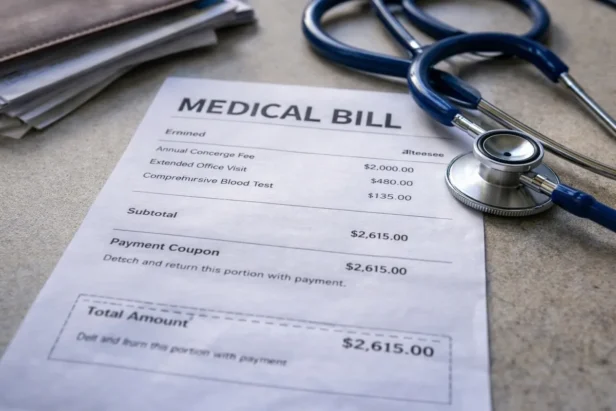
The number of concierge medical practices in the United States has nearly doubled over the past five years. California is leading the trend. The model works like this: a clinic switches to a new operating structure, patients get a letter. To stay on as a patient, they must pay an annual membership fee — anywhere from $2,000 to $10,000 a year, on top of regular insurance. Those who don’t pay find a new doctor.
This isn’t boutique medicine for the wealthy. Twenty years ago, concierge clinics genuinely were a luxury — $25,000 a year, a personal physician on call around the clock, hour-long appointments. The model has since shifted. Ordinary family and primary care practices are now adopting what’s called a hybrid structure: the doctor still accepts insurance, but charges patients a fixed annual fee for “enhanced access.”
What the numbers show
A study published in December 2025 in Health Affairs put the first hard numbers on the phenomenon. Researchers from Johns Hopkins, Oregon Health & Science University and Harvard Medical School analyzed a national sample of more than 6,000 practices over six years. Their finding: between 2018 and 2023, the number of concierge and direct primary care clinics in the U.S. grew 83.1% — from 1,658 to 3,036.
The number of physicians moving into these models rose 78.4% over the same period. The workforce composition also shifted: the share of physicians among concierge practitioners fell from 67% to 60%, with nurse practitioners and physician assistants filling the gap.
About 60% of these providers still accept Medicare — meaning most operate on a hybrid basis, collecting both insurance reimbursements and membership fees. Pure cash-only practices that have abandoned insurers entirely remain a minority.
What it costs
Prices vary widely. Nationally, a typical annual concierge membership runs $2,000 to $5,000. In California, the range is $3,000 to $8,000 and up. In Los Angeles, monthly fees can reach $900 — nearly $11,000 a year. In Orange County, they run $300 to $600 a month. San Diego is somewhat cheaper, starting around $250. The California premium reflects the same factors that inflate everything else in the state: rent, salaries, cost of living.
Hybrid practices that retain insurance billing typically charge less — sometimes a few hundred dollars a year. But there are no uniform standards, either for the fee amount or for what it actually covers. Some clinics include expanded lab panels and longer appointments. Others offer only priority scheduling and the ability to message a doctor directly. Many patients learn about the new fees only after they’ve already made an appointment.
Why doctors are leaving the traditional model
A typical primary care physician in California manages 2,000 to 3,000 patients. Appointments run 10 to 15 minutes. On top of that comes a torrent of messages through online patient portals — volume that doubled during the pandemic. Doctors spend hours on correspondence with patients, time for which they receive no compensation.
UCSF Health tried a different fix. In November 2021, it began billing for MyChart portal messages when a response required medical judgment and more than five minutes of a physician’s time. Patients on Medicaid pay nothing; those with private insurance pay a copay of around $20. A UCSF study published in JAMA in 2023 tracked 5.5 million messages over 94 weeks. Message volume fell by roughly 2%. The burden on staff was barely affected.
The concierge model offers physicians a different way out. Instead of 2,000 patients, a doctor carries 400 to 600. Appointments run 45 to 60 minutes. Patients get direct access. In exchange, they pay extra. For the doctor: less burnout and higher income. For the patient: better care — if they can afford it.
What it means for everyone else
Every physician who converts to a concierge practice takes 400 to 600 patients with them. The remaining 1,500 to 2,500 they previously served are left without a primary care doctor. According to the UCSF Healthforce Center, roughly 7 million Californians — about one in six — already live in areas with a shortage of primary care physicians. In some communities, the wait for a new doctor stretches to eight months.
California’s shortage was already acute before the concierge trend accelerated. The state will need more than 4,000 additional primary care physicians by 2030 — an increase of nearly a third over current levels. Only two regions, Greater Bay Area and Sacramento, currently have adequate supply.
The Johns Hopkins researchers are direct in their warning: the growth of paid care models benefits those who can afford them while deepening inequity for everyone else — particularly elderly patients on Medicare, those with chronic conditions and low-income residents.
This article is for informational purposes only and does not constitute medical advice. Consult a licensed healthcare professional for diagnosis or treatment.