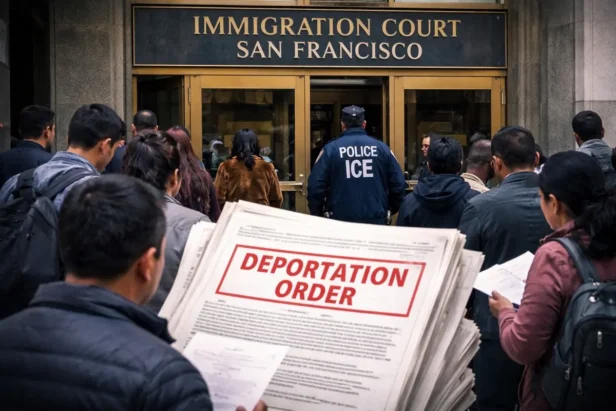
Last week, immigration judges in San Francisco issued more than 800 in absentia deportation orders — rulings against people who never showed up for their hearings. The figure comes from Milli Atkinson, director of the immigrant legal defense program at the San Francisco Bar Association, who reported it to KQED.
An in absentia ruling means this: a person misses their hearing, and the court automatically orders their removal. The consequences are severe — years-long bars on reentry, loss of eligibility for immigration benefits, and an open warrant for ICE to detain and deport at any time.
What Happened
Observers noticed something unusual during the week of March 17. Judges from the immigration court in Concord were reassigned to San Francisco. Instead of the standard schedule — one morning session, one afternoon — hearings ran back to back with no breaks. Each session called 20 to 30 people simultaneously.
At one hearing, 77 people were summoned. Three appeared. The remaining 74 received deportation orders.
Under normal circumstances, five to ten people fail to appear at any given hearing. Eight hundred in a single week is a number that has no precedent. Atkinson believes the real figure is even higher — not every hearing had observers present.
Why People Didn’t Come
Many simply didn’t know their hearings had been moved. The San Francisco immigration court system descended into chaos: hearing dates were rescheduled without warning, some pushed back by two years from their original dates, others pulled forward with days’ notice. Notices went out by mail — to outdated addresses, with misspelled names.
Shira Levine, a former immigration judge fired by the Trump administration in September 2025, told Mission Local she knew of cases where people were initially scheduled years out and then received letters demanding they appear within days.
Fear was the other factor. After ICE began arresting immigrants outside courthouse buildings, many stopped coming to hearings altogether. In December 2025, federal judge Casey Pitts banned ICE arrests near courts in the San Francisco region. But the fear has not gone away.
What Has Happened to the Court
The immigration court at 100 Montgomery Street is the largest in Northern California and handles most Bay Area cases. At the start of 2025, it had 21 judges. According to Mission Local, two remain. Twelve were fired; the rest retired, requested transfers, or were reassigned. Some cases are now heard by a judge in San Diego, by video.
The court is scheduled to close by the end of 2026 — the building’s lease on Montgomery Street is not being renewed. KQED reports the remaining cases are expected to move to the Concord court. The court’s current backlog: 120,000 unresolved cases.
What It Means
Atkinson said the court appeared to be scheduling hearings in ways designed to ensure people wouldn’t appear — mass summons, compressed timelines, notices that never reached recipients. In her assessment, the pattern looks like a procedural mechanism to strip people of the opportunity to seek asylum.
The only way to undo an in absentia deportation order is to file a motion to reopen — and to prove either exceptional circumstances, such as a serious illness, or that the hearing notice was never received. Both paths require an attorney. Most of those affected don’t have one.
The Executive Office for Immigration Review, the federal agency that oversees immigration courts, did not respond to KQED’s request for comment.