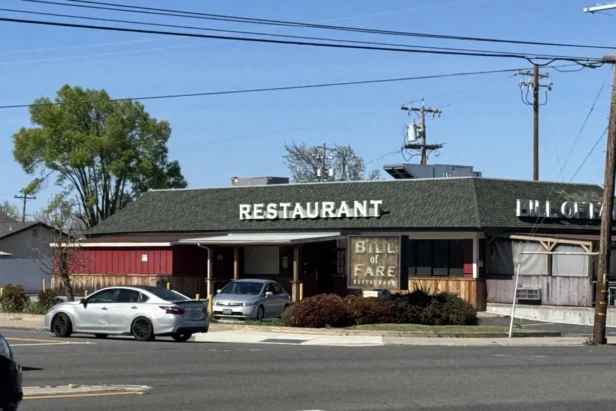
When a guest finishes dinner at La Cigale in Glen Park, the check arrives. It reads $140. No tax, no service charge, no tip line. Sign and you’re done. In San Francisco — where a decent dinner for two typically balloons by 20–25% in gratuity, 10% in tax, and sometimes a service fee on top — this feels like a dispatch from the future.
Tipflation: Why America Got Tired of Paying Twice
The problem grew out of the pandemic. During COVID, restaurants shuttered, workers lost their jobs, and diners were urged to leave more. The old 15–20% norm crept upward. Then came the Square and Toast tablets with preset options — 22%, 25%, 30% — spinning toward the customer at coffee shops, bakeries, and even self-checkout counters.
According to Bankrate’s 2025 survey, 41% of Americans now say tipping culture has gotten out of control — up from 35% a year earlier. Overall, 63% hold at least one negative view about tipping. Two in five said the cost of living has pushed them to tip less.
There’s a generational fault line, too. Eighty-four percent of boomers and 83% of Gen Xers say they always tip at sit-down restaurants. Among millennials, it’s 61%. Among Gen Z — 45%.
La Cigale: A Restaurant With No Tip Line
Joseph Magidow, chef and owner of La Cigale, opened the restaurant in Glen Park in the fall of 2025 with an all-inclusive model from day one. Fourteen seats around an open hearth. Southern French cooking. $140 for a tasting dinner — everything included.
Magidow frames the decision in two parts. For the guest, it’s transparency. The number on the check doesn’t sprout surprise charges. For the staff, it’s stability. Servers earn a flat rate of roughly $40 an hour regardless of how busy the night gets. They also receive four weeks of paid vacation — virtually unheard of in the restaurant business.
Claire Bivins, a server and sommelier at La Cigale, says the fixed pay removes the nightly anxiety. Yes, there are no windfall tip nights. But there are no nights where you walk out with almost nothing, either.
Zazie: Ten Years Without Tips — and Without Catastrophe
La Cigale isn’t San Francisco’s first experiment. Zazie, a French bistro in Cole Valley, dropped tipping back in 2015. Menu prices went up 20%, but servers got stable wages, profit-sharing, and full benefits. Founder Jennifer Piallat sold the restaurant in 2020 to three employees with a combined 50 years at the place — and they’ve kept the model intact. The restaurant has over 5,500 reviews on Yelp and a 4.7 rating on OpenTable. A decade later, it’s still packed.
Why Other Restaurateurs Push Back
Not everyone thinks the model works. Derek Simms, who runs multiple restaurants in Frisco, Texas, argues that the traditional system actually benefits servers the most. By his estimate, strong servers pull $40 to $60 an hour with tips. Kitchen staff, meanwhile, earn significantly less — and restructuring pay across the entire operation is a lift most businesses can’t handle.
Simms warns that paying everyone a flat $15 to $20 an hour would wipe out a restaurant’s margins and eventually force it to close. The alternative is cutting staff or watching service quality slide. In California, he says, that scenario is already playing out.
Vicki Parmelee, owner of Jumby Bay Island Grill in Jupiter, Florida, puts it differently. Without tips, servers lose the incentive to go the extra mile. Service suffers. She has no plans to try the model.
Michelle Korsmo, president and CEO of the National Restaurant Association, points to the numbers: the median hourly earnings for a tipped server in the U.S. come to $27. That earning potential, she says, is a major reason people choose the profession.
The California Wrinkle
California’s tipping landscape looks different from most of the country. The state minimum wage hit $16.90 an hour on January 1, 2026. In San Francisco, it’s $19.18 — among the highest in the nation. California also bans the tip credit, a mechanism that lets employers in other states pay servers as little as $2.13 an hour on the assumption that tips will make up the difference. Here, a server gets the full minimum wage plus tips on top.
That means California servers are already better protected than their counterparts in Texas or Florida. But for the restaurateur, tips aren’t a way to keep wages low — they’re additional income for the employee. Removing them and folding the cost into menu prices is a fundamentally different financial equation.
What’s Actually Happening on the Ground
A handful of San Francisco restaurants have tried switching from tips to service charges — among them Che Fico and Good Good Culture Club. Both eventually reverted. Pasta Supply Co. introduced all-inclusive pricing at one of its two locations, then walked it back. La Cigale and Zazie remain the exceptions rather than the rule.
For a high-volume casual restaurant, the formula doesn’t pencil out yet. For a high-end spot with a fixed menu and a controlled flow of guests, it might. The gap comes down to scale, headcount, and margin.
What It Means If You Live in San Francisco and the Bay Area
If you live in San Francisco or anywhere in the Bay Area, tipping is a daily friction point. The screen spinning toward you at the coffee shop with 20–25–30% options on a $7 latte is a familiar ritual of low-grade guilt. A dinner for two at $120 on the menu quietly becomes $170 after tax and tip. A $40 haircut turns into $50.
You can’t skip the tip at a sit-down restaurant in America without social consequences — not yet, anyway. But the mood is shifting. Restaurants are experimenting. Surveys show rising frustration. Gen Z already tips half as often as boomers. The question isn’t whether the system will change. It’s how fast — and who picks up the tab for the transition.