The first version of this article was published in December 2025. It has been fully rewritten with updated data as of March 2026.
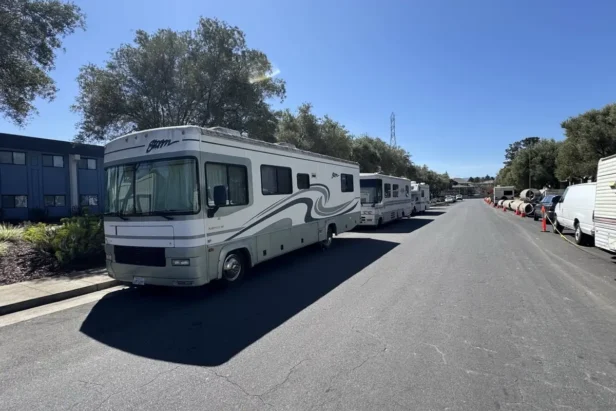
Rusty bumpers. Curtained windows. Solar panels duct-taped to rooftops. Flat tires. Endless rows of white vans lining the curbs of Oakland, San Francisco, and the outskirts of San Jose. Just two years ago, this was a well-oiled survival system — thousands of people had been living in RVs on the streets of the world’s most expensive region for years, and the city couldn’t do a thing about it. Literally: the courts wouldn’t allow it.
In 2025, the rules changed. What used to be a game of hide-and-seek with municipal inspectors turned into a full-scale displacement operation. San Francisco imposed a two-hour parking limit, San Jose cleared the largest encampment in the city’s history, and the governor signed a law allowing the destruction of RVs valued at up to $4,000. By March 2026, the first results are in. They’re mixed.
The Legal Turning Point: Courts Green-Light Evictions
For a long time, RV residents were shielded by a landmark 2018 ruling — Martin v. Boise. The logic was straightforward: you can’t punish a person for sleeping on the street if the city hasn’t offered them a shelter bed. For the Bay Area, with its chronic housing shortage, this effectively meant immunity. Police issued citations, but courts threw them out. Tow trucks showed up and left empty-handed.
On June 28, 2024, the U.S. Supreme Court handed down its decision in Grants Pass v. Johnson. In a 6–3 vote, the justices ruled that cities have the right to fine and remove people from the streets — even when no shelter beds are available. The opinion was written by Justice Neil Gorsuch. Justices Sotomayor, Kagan, and Jackson dissented.
Exactly one month later, on July 25, 2024, Governor Gavin Newsom signed an executive order directing state agencies to begin clearing encampments on California’s public lands. By that point, Caltrans had already dismantled more than 11,000 camps along highways since 2021. The order formalized the practice and extended it to all state agencies — parks, waterways, infrastructure.
For Bay Area mayors, this was the signal. As people were pushed off state land — from under bridges, along highways, off shoulders — they flooded onto city streets. Municipalities had to act.
San Francisco: A Two-Hour Limit and 320 Permits
In May 2025, the city’s Healthy Streets Operations Center conducted a count. They tallied 501 oversized vehicles on San Francisco’s streets. Of those, 437 were being used as housing. By June, the number had risen to 612 — a 29% increase year over year, even as tent encampments had been cut in half. People were moving out of tents and into vans.
On July 22, 2025, Mayor Daniel Lurie signed a law as part of the Breaking the Cycle program. The gist: all oversized vehicles — longer than 22 feet or taller than 7 feet — are banned from parking on any city street for more than two hours. This makes living in a van physically impossible. Every 120 minutes, you have to start the engine and find a new spot.
The only escape hatch is the Large Vehicle Refuge Permit program. Those registered in the city’s database before May 2025 who agreed to social services were issued a six-month permit — a blue sticker on the rear window. The permit exempts holders from the two-hour limit but requires them to accept the first housing offer from the city and surrender the RV.
The city allocated $13 million over two fiscal years: subsidies for rapid rehousing, outreach teams, and a vehicle buyback program. The buyback works on a formula: $175 per linear foot of RV length, bumper to bumper. A standard 22-foot RV comes out to roughly $3,850. Payment is split into two installments: part at signing, the rest when the person accepts a housing offer. After buyback, the vehicle goes to the scrapyard.
Enforcement began on November 1, 2025. By January 2026, the program looked like this: 320 permits issued, 11 families moved into housing. Eleven out of three hundred and twenty.
On the ground, things proved far messier than the plans on paper. In Bayview, one of the first sweeps took place on November 5. A team of roughly fifteen police officers and city workers arrived to tow unpermitted RVs. Miguel Sandoval was eating lunch at the time. By the time he reached the site, the trailer housing his 15-year-old brother and 18-year-old sister was already on the flatbed. His brother was at school. His sister was at a job interview. The family had been denied a permit: the trailer wasn’t registered in Sandoval’s name.
In December 2025, a scandal broke. Several RV residents reported that a city Homeless Outreach Team worker had been selling permits for $250–500. The permits are free, and the city had stopped issuing new ones. An investigation was opened.
In February 2026, SFMTA suspended the use of Pier 68 for storing towed RVs — following complaints from neighborhood residents. The agency is searching for an alternative site.
The first permits expire in April 2026. The city has promised to extend them for those who haven’t yet received a housing offer. But at this point, 11 families out of 320 is 3.4%.
San Jose: Columbus Park and the Whack-a-Mole Effect
San Jose took a different approach. Instead of a citywide ban — targeted zones. In November 2024, the city launched the OLIVE program — Oversized and Lived-In Vehicle Enforcement. Budget: $3.3 million. The concept: select 30 temporary zones with the highest concentration of RVs, post signs, give a week to move, then tow.
Zones were selected using several criteria: proximity to schools, parks, waterways, and storm drains; the number of accumulated vehicles; the volume of trash and biowaste on sidewalks. The first zone was Chynoweth Avenue — 19 occupied RVs. Next came Boynton Avenue. By summer 2025, enforcement had been carried out in 38 zones containing a combined 1,175 vehicles.
Ninety days after a sweep, city inspectors recounted the vehicles on the same streets. The result: 671 had returned. More than half.
The ultimate test was Columbus Park — San Jose’s largest encampment since The Jungle, which was cleared in 2015. By August 2025, 370 people were living in and around the park: in over 100 RVs, tents, and makeshift shelters. In the preceding year, the park had seen a homicide, a pedestrian death, and a suicide.
On August 18, 2025, Mayor Matt Mahan launched a three-month clearing operation. Garbage trucks, tow trucks, police. Simultaneously, the city opened five motels converted into transitional housing and San Jose’s first-ever Safe Sleeping Site — a 56-bed tent camp with food, showers, and social workers on Taylor Street.
RV residents were offered a buyback program — $2,000 per vehicle, but only if they moved into a motel. By October, the park was fully cleared. The city reported 250 people placed into housing. The park was fenced off to prevent return. The mayor promised to restore the baseball diamond and open a dog park.
But around 40 Latino families refused to give up their RVs. They drove 21 vehicles to a vacant lot owned by Kellanova (formerly Kellogg), next to Columbus Park. Days later, they were asked to leave again. County Supervisor Betty Duong learned about the lot clearance less than 24 hours in advance.
In January 2026, the Mercury News published an interim assessment of OLIVE. Chynoweth Avenue — a success. Mona Way, on the border of San Jose and Campbell — a failure. One RV had caught fire back in March 2025. The city cleared the street over the summer. By December, there were more RVs than before the sweep. Residents summed it up in two words: “motor home shuffle” — cleared from one street, they appeared on the next.
In the 2025–2026 fiscal year budget, the program was expanded to 50 zones.
The State Level: AB 630 and the Right to Scrap
In October 2025, Governor Newsom signed Assembly Bill 630. The law allows Alameda County and Los Angeles County to scrap “abandoned” RVs valued at up to $4,000 — eight times the previous limit of $500. Previously, RVs worth more than $500 were sold at auction. A buyer could park the vehicle back on the same street a week later. Now — it goes to the crusher.
The mechanics: a police officer or authorized agent affixes a warning to the RV — 72 hours to move it. After towing, the owner has 30 days to reclaim. If unclaimed — destruction. But only if the vehicle is deemed “inoperable” or poses a safety hazard.
The law immediately hit a legal wall. The City of Los Angeles tried to apply AB 630 right away — the city council voted 12–3 in December 2025 to launch the program. But in February 2026, federal judge Curtis Kin blocked the attempt. The law’s language is unambiguous: the authority was granted to the counties of Alameda and Los Angeles, not to cities within those counties. LA acted without legal standing. A bill currently before the California Legislature, AB 647, would amend the law to extend authority to municipalities.
For the Bay Area, AB 630 currently affects only Alameda County — meaning Oakland, Berkeley, Fremont, and surrounding cities. San Francisco and San Jose are in different counties and fall outside the law’s scope.
The Economics of Displacement: Why Cash Works Better Than Tow Trucks
Forcibly towing and scrapping a single inoperable RV costs a city budget $1,500–2,500 — due to the size, hazardous fluids, and required storage. Buyback programs are cheaper and more effective. San Francisco pays $175 per linear foot. San Jose offered a flat $2,000 at Columbus Park. Berkeley went further: in early 2025, the city cleared an encampment on 2nd Street, offering $175 per foot plus a motel room. Twenty-nine of 32 owners accepted. The UCSF Benioff Homelessness and Housing Initiative began studying the Berkeley model as a potential standard.
The critical element in all these programs is the physical destruction of the purchased vehicle. The RV is sent to the scrapyard and registered with the DMV as destroyed. This breaks the cycle known in Los Angeles as the “vanlord pipeline”: investors bought decommissioned RVs at auction for $50–100 and rented them to homeless individuals — no plumbing, no electricity, no safety standards whatsoever.
For those willing to leave entirely, cities offer Homeward Bound — a free one-way ticket to any state where the person has relatives.
Where Do They Go?
According to the 2024 Point-In-Time Count, more than 1,400 people live in vehicles in San Francisco alone. Ninety percent of homeless families live in cars, not tents. In Santa Clara County — over 6,500 homeless individuals, roughly 1,000 of whom live in RVs on San Jose’s streets. Across California, one in three unsheltered homeless people sleeps in a vehicle.
Official Safe Parking Sites are at capacity. San Jose’s largest site, Berryessa, holds 85 vehicles — less than 10% of the need. The city has no plans to open additional lots, betting instead on motels and tiny homes.
Those who don’t take the city’s deal move further out. To the Central Valley — toward Stockton, Modesto, Fresno, where land is cheaper and enforcement is weaker. Some relocate to the industrial zones of North San Jose, where no-parking signs haven’t yet been posted. Some downsize from RVs into passenger cars — which the two-hour limit doesn’t cover.
For Bay Area residents, the crackdown looks like long-overdue relief. Mayor Mahan reports that trail usage at Columbus Park has doubled since the clearing. Mayor Lurie calls the program “a combination of compassion and accountability.”
Advocates see something different. Jennifer Friedenbach of the Coalition on Homelessness keeps repeating: people who lose their RVs will end up on the sidewalk. Outreach workers won’t be able to find them once their RV is in the scrapyard. Eleven families out of three hundred and twenty — that’s not a rehousing program. That’s a displacement program.
The ring is tightening. The valley that once promised freedom and innovation is closing its doors on those who were just trying to survive in it.
Updated March 16, 2026