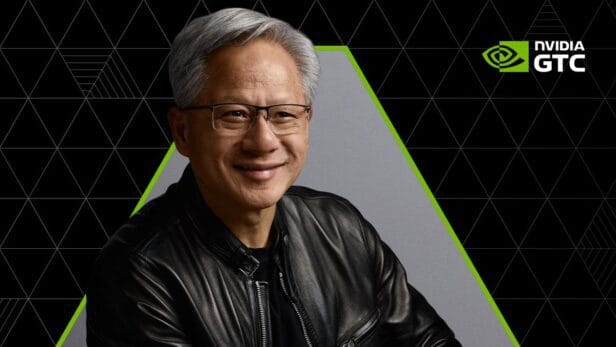
On Monday, March 16, Nvidia CEO Jensen Huang took the stage at the SAP Center in San Jose — home of the San Jose Sharks — and delivered a two-hour-plus keynote to 30,000 attendees. GTC, the annual GPU Technology Conference widely dubbed the “Super Bowl of AI,” runs through March 19. For the Bay Area, this is a hometown event. Many of the announcements directly affect the region’s jobs, infrastructure, and energy grid.
The headline number: combined purchase orders for Blackwell and Vera Rubin chips are on track to hit $1 trillion through 2027. A year ago, at GTC 2025, Huang projected $500 billion. The forecast has doubled. Demand is surging from startups and hyperscalers alike — Amazon, Google, Microsoft, Oracle, Meta, OpenAI, and Anthropic are all building on the new platform. AWS plans to deploy over one million Nvidia GPUs.
Vera Rubin: Seven Chips, One Platform
The centerpiece announcement is the Vera Rubin platform. Not a single chip — seven of them: the Rubin GPU, Vera CPU, NVLink 6 Switch, ConnectX-9 SuperNIC, BlueField-4 DPU, Spectrum-6 Ethernet Switch, and the Groq 3 LPU, an inference accelerator built on Groq’s technology and integrated into the platform. All seven are designed to operate as a single AI supercomputer. The NVL72 rack — 72 GPUs, 36 CPUs, fully liquid-cooled — is already shipping to hyperscalers.
Rubin GPU specs: 336 billion transistors, 288 GB of HBM4 memory, 50 petaflops of inference performance per chip. Nvidia claims a 10x improvement in performance per watt over the previous Grace Blackwell generation. In an industry where data center power bills have become a political issue, that matters.
The Vera CPU is Nvidia’s first fully custom data center processor. It features 88 Olympus cores on Arm architecture, LPDDR5X memory with 1.2 TB/s bandwidth, and twice the single-thread performance of its predecessor, Grace. Nvidia built it specifically for AI inference workloads — the kind of always-on, tool-calling operations that AI agents perform around the clock.
The $20 Billion Groq Deal Bears Its First Chip
According to CNBC, Nvidia closed the largest deal in its history in December 2025 — gaining access to Groq’s technology and team in a transaction valued at approximately $20 billion. Groq was founded by the creators of Google’s TPU, a chip that competed directly with Nvidia’s GPUs. The deal was structured as a technology license and acqui-hire, bringing over key employees including Groq founder Jonathan Ross and president Sunny Madra. Groq remains a nominally independent entity, and its GroqCloud service continues to operate. Key personnel and a significant portion of Groq’s intellectual property are now under Nvidia’s control.
GTC marked the first public result: the Groq 3 LPU, a chip purpose-built for inference acceleration. Its architecture is fundamentally different from a GPU. The Groq 3 is optimized for decode — the final stage of token generation. Each LPU packs roughly 500 MB of on-chip SRAM with 80 TB/s bandwidth per chip. A single LPX rack houses 256 of them. The intended workflow: the Vera Rubin GPU handles the heavy compute, the LPU accelerates the response. Nvidia claims up to 35x higher inference throughput per megawatt compared to GPU-only configurations. Samsung is manufacturing the chip. Shipments are expected in Q3 2026.
OpenClaw and NemoClaw: AI Agents Go Enterprise
Huang devoted a significant portion of the keynote to OpenClaw, an open-source platform for building autonomous AI agents. According to Huang, it has become the fastest-growing open-source project in history. Nvidia introduced NemoClaw — its own stack layered on top of OpenClaw, installable in a single command. NemoClaw adds enterprise-grade security: sandboxing, a privacy router that directs traffic between local and cloud models, and data protection guardrails.
Huang compared OpenClaw to past platform shifts. “Mac and Windows are the operating systems for the personal computer. OpenClaw is the operating system for personal AI,” he said. Every company in the world needs an OpenClaw strategy — the way they once needed a Linux strategy or an HTTP strategy. According to Nvidia, Microsoft Security is already using Nemotron and OpenShell for adversarial AI detection, reporting a 160x improvement in efficiency.
Robotaxis, Robots, and Olaf on Stage
Huang called autonomous vehicles “the first multi-trillion-dollar robotics industry.” He announced that Uber plans to launch robotaxis powered by Nvidia’s Drive AV platform across 28 cities on four continents by 2028, starting with Los Angeles and San Francisco in 2027. Nissan, BYD, Geely, Isuzu, and Hyundai are building Level 4 autonomous vehicles on Nvidia’s Drive Hyperion program. Isuzu and China’s Tier IV are developing autonomous buses.
On the robotics front, Nvidia said it is now working with every major industrial robot manufacturer — FANUC, ABB, Figure, and Agility among them. Near the end of the keynote, a physical Olaf robot from Disney’s Frozen walked onto the stage and talked with Huang. According to Nvidia, the robot was powered by the company’s physical AI stack, the Newton physics engine, and Omniverse simulation.
Roadmap Through 2028
Huang laid out a four-generation plan. Now: Blackwell (consumer RTX 50 Series is shipping, DLSS 5 update coming this year). 2026: Vera Rubin for data centers, with consumer derivatives in 2027. 2027: Vera Rubin Ultra with an upgraded GPU and a new Kyber rack architecture scaling to 144 GPUs. 2028: Feynman — a new GPU, a new CPU called Rosa, and new networking components.
Nvidia also announced the Nemotron Coalition, an alliance built around six families of open models: Nemotron (language and reasoning), Cosmos (world generation and vision), Isaac GR00T (robotics), Alpamayo (autonomous driving), BioNeMo (biology and chemistry), and Earth-2 (weather and climate). Partners include Mistral, Cursor, Perplexity, Black Forest Labs, and others.
By the Numbers
Nvidia is the world’s most valuable public company as of March 16, with a market cap of $4.45 trillion. Revenue this quarter is expected to grow roughly 77% year over year to approximately $78 billion. That marks the eleventh consecutive quarter of revenue growth above 55%. AI now accounts for about 60% of the company’s business.
Huang’s central thesis: the era of training AI models is giving way to the era of inference — where systems stop learning and start doing real work. AI agents are now talking not just to humans but to each other, driving exponential demand for compute. Nvidia calls this the fourth AI scaling law: agentic scaling. The term is new. The bet behind it is concrete — more agents, more tokens, more chips. In practice, that means AI services will get faster and cheaper, while demand for data centers and energy keeps climbing.
Nvidia shares rose about 2% on Monday. The conference runs through Thursday.
Photo: Nvidia